

>
| James (0:08) | You are listening to a podcast from the Health Tech Research Centre in Brain and Spinal Injury. My name's James Piercy and I'm chatting to anybody with any interest in trauma sciences and brain injury in particular. And today I'm really pleased to be joined by Mary-Anne Cordeiro who is developing, well I'll let Mary-Anne tell you all about it.
Mary Anne, what are you doing? What is the name of your organisation? |
|
| Mary Anne (0:31) | So first of all, the name of our organisation is Thermo Trauma Port. That's quite a mouthful, but it does stand for thermo as in heating, trauma as in trauma and port as in something that's portable. So we abbreviate it to TTP, but we also have trademarked the logo with the name cocoon because whenever we talk to anyone, we get the impression of cocooning someone and securing them.
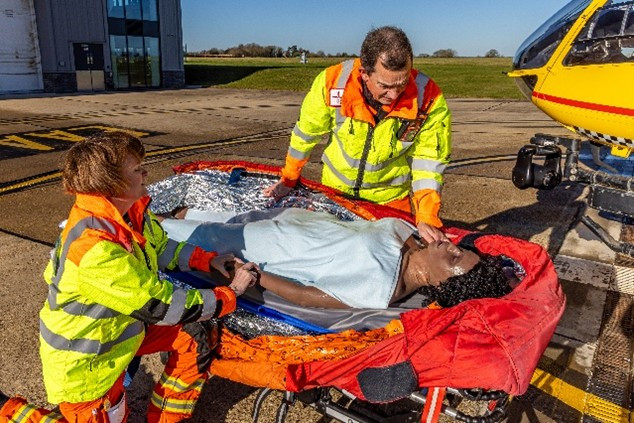
So it is a patient transfer device that stays with the patient from the site of the accident all the way through their journey and keeps them warm. |
|
| James (1:09) | Yeah, so that sounds like a kind of a simple idea for people to get their heads around. There's a couple of really important things that you mentioned there though, and the first one is that it stays with the patient. So normally what happens, an ambulance rolls up, they throw somebody in the back of the bus, they take them off to hospital and throw them out of the bus again, after a 20 hour wait, usually, and then they get dealt with in hospital.
So the stretcher stays with the hospital, with the ambulance crew, rather than with the patient. |
|
| Mary Anne (1:39) | So I'd love to say I was the first person who thought of this idea, but actually the story of the TTP goes all the way back to 2008, when I had a material that had been developed out of UCL and it wasn't fit for purpose for whatever it was doing. And this is a typical example of technology looking for an application. So I went off and talked to two doctors from East Anglian Air Ambulance and I said, could you use this for fracture management?
And without hesitation, they said, when we get called out to the scene of an accident, a broken arm or a broken leg is minor. It isn't our most important thing. The most important thing is stabilising the patient. And the worst thing that we do is we keep on moving the patient. So we pick them up on a scoop stretcher. We put them onto our air ambulance trolley. We get to Addenbrookes. We can't land on the roof. So we then have to decant them onto an ambulance trolley. Then they get to the A&E and they get decanted onto an A&E trolley. And this is all before you've done a CT scan to see whether they've got a broken spine or internal organ injuries. And so what we really need is something we can use all the way and keep them warm, because when people are either haemorrhaging blood or are in trauma, they really can't regulate their body temperature. And so that was the genesis of the stories. The idea of this is you pick them off of the side of the road, you put them on the TTP, which is on the first trolley that is there, and they stay on that. So you don't log roll them or pat slide them onto the next trolley or bed. And you even put them through a CT scanner because we're radiolucent. We've just finished a trial with the National Physics Laboratory that shows we have no artefacts. And so you can keep them on all the way until you're absolutely sure that you can move them. |
|
| James (3:47) | Yeah, my accident was quite a long time ago now, but you've described it. So it was the East Anglian Air Ambulance who picked me up and they put me on a trolley in their lovely helicopter. And then that was so long ago, there wasn't a helipad to land on.
So I had to get transferred into an ambulance from the airport and driven to Addenbrookes. And then I was put onto another trolley to go in to check over and then on another one to go into the CT scanner. And then finally get into a ward. So I can see the sense of that, that we're not moving patients who are obviously vulnerable to further injury while we're doing that and kind of carry them with. And I guess the other thing that's important is that they want to get it back. So the ambulance crew have got this lovely thing and it's cool. And they put the patient into it, but they'd kind of like to have it back for the next person, wouldn't they? So I guess you need to be able to track where it is all the time. |
|
| Mary Anne (4:30) | Yes. Now this isn't a problem when we're working with the military because they own a certain number of things. When we come to the civilian use of this, what EAAA will probably do is buy three of these, keep one at each of the hospitals they fly into.
And when they’ve left the patient, they will take one with them and then go to their next one. Now, obviously over time, this will change and the hospitals will have their stock of TTPs. But we know from East Anglian Air Ambulance’s experience that they actually brought in the plastic scoop stretchers, before they used to be metal. And after some time, the hospitals actually realised those are much better to use. And so they stopped using the metal ones and started to use the plastic ones. But it is a question of who needs it first. And it is the emergency trauma services that will use it first rather than the hospitals themselves. |
|
| James (5:41) | Yeah, to track it in. I like the idea of them turning up in their helicopter and asking for the empties, delivering to a pub or something. And so you mentioned the other important thing about this device is that it's not just a kind of cold flat board, but actually warms and presumably insulates the patient while they're being transported to keep that body temperature up. | |
| Mary Anne (6:02) | So the idea, obviously, is not to lose body temperature, OK? So our battery is long lasting enough to keep them at 36 degrees at least for five to six hours, which is more than enough to transport them into hospital where you're hoping that they're warm. But the other problem is when you were transferring them before you got into hospital, every single time you made the transfer, their body lost heat to that trolley.
We've got a lovely picture that shows the scoop stretcher at 11 degrees and ours at 36 degrees. Well, which would you prefer to be lying on? The other thing that we have is a single use disposable cover. So a lot of these patients are losing blood, fluids, etc. And so the ambulance crew lose a lot of time decontaminating equipment when they get to hospital. And obviously, what we're saying is you keep the patient on our TTP, which has a single use disposable cover on it. And when they finally reach their bed, you take that cover off, incinerate it and give the TTP back to whichever service brought you in. So you send it back to ED. |
|
| James (7:26) | Yeah, and pass it back in. So we're looking at sort of body temperature to maintain that kind of core temperature. Does the device actually measure the temperature of the patients while they're travelling on it?
Or are you just sort of doing testing and verifying that, yeah, it's going to maintain that core temperature? |
|
| Mary Anne (7:41) | We're doing some testing at the moment at University of Portsmouth, which have an extreme environment laboratory. And we did a feasibility study there in November. Obviously, ethics had to be used because we were using healthy volunteers.
But they are very used to doing things for sports, the Navy, people who are climbing Mount Everest, etc. And they have chambers that can be kept constant temperature. So the study that they did for us using four healthy volunteers was to take these four people who'd agreed and are being paid some money, you'll be glad to know, at 10 degrees. That doesn't sound very cold, except if you're there for three hours and you're in a T-shirt and shorts. And they have them rigged up so they can test their skin body temperature at various positions, particularly at the scapula, the bum and the feet. And they check blood flow, they check heart rate, they check a whole lot of physiological things, as well as perceptual things. So they ask at intervals, how the person is feeling. And what was very interesting is that they compared the body temperatures and here we use a rectal probe. You know, you wouldn't go around ambulances putting rectal probes up people, but in a laboratory situation you do. And it was very clear that with the TTP, when they came in at about 37 degrees, they went down slightly, but then they recovered all the way up to 37. The scoop, it continues to go down and down and down and down. So this is very early days of measuring, because obviously four volunteers are not enough. But it does show you that it is doing what we expect it to do. |
|
| James (9:38) | Yeah, so it demonstrates that it has that kind of capability. So you mentioned that it's heated with a battery. Yes.
And I'm guessing that we're talking about helicopters in particular, weight is really important. So presumably you've got to really kind of, you know, maximise the power you've got and minimise the weight you've got in the battery. |
|
| Mary Anne (9:55) | We're using a military grade battery, which weighs about one kilo at the most. But it has been used by the military for radios, comms, it's been tested in aircraft, etc. And actually, we were asked when we went to demo the TTP at the Special Operations Medical Association in America to change our battery because we had our own battery.
But they said, if you could use this, it would be used even more ubiquitously in NATO, as well as the US. And given what geopolitics is like, we took their advice. |
|
| James (10:35) | Yeah, sounds sensible, sad enough to say. So you talk quite a bit about the military. Is that the sort of the first really port for this thing to be used, you think?
Will it move into sort of public a bit later? Are the military More likely to adopt? |
|
| Mary Anne (10:52) | This was all very frustrating for me, James, because obviously, we got funding, actually, we got funding from the NIHR, the National Institute of Health and Social Research, which is part of the NHS. And they really liked the idea because they could see a place for it. So having got up to about a million pounds from them, Brexit then happened.
And with Brexit, we have an active device. So we are classed as a class 2B device. There was no notified body who would review our technical file. They wouldn't even give us a date. Because of the Brexit, the UK CA mark was all that you could do. And it was as rigid as that. And of course, Siemens and Medtronic and all these other big players had deeper pockets than we did and were first in the queue. There were two things that happened around that time, other than me tearing my hair out and getting greyer and greyer. First, in November 2023, my elderly mother had a fall in our house in the UK. And the housekeeper called me and said she couldn't get mum off the ground. She was conscious. But could I send someone to help? I couldn't find anyone. So I drove from London to my mum's house. And I got there and we both couldn't move her off the ground. And then I remembered I had the TTP in the boot of my car. It was the 5th of November. So whilst we'd call the ambulance, it seemed like lower priority. Anyway, fortunately, I got it out of the boot of my car and we put mum on it. And we actually used it to move her away from the draft into the living room. Well, we didn't realise how long the wait was going to be, but it was five hours. And I know that that saved my mother's life. So I kind of thought, OK, I know this was good, but this has now saved my mother's life. And it so happens that one of our angel investors owns a care home. He says that this happens a lot in their care homes, that they have to wait for an ambulance to come because they don't pick the patient up because that's what the protocol is. And he did say it's a cause of death and hypothermia. So that was a story which made me think, OK, hang on, Mary Anne. And in January that year, our regulatory advisor found out that our device in the US, it doesn't need anything other than registration because there is a heating pad in the US market that we can go under in the same code, which is 510k exempt. So that's why we decided, OK, we'll go in the US first. And we have a distributor who sells to the military. And in the meantime, a lot of statistics have been done about Iraq and Iran and Afghanistan. And there was a statistic that was very meaningful, which is that 66% of casualties who entered the ED in Afghanistan were hypothermic. And 82% of those who died were hypothermic. So we knew that the US military would be the first because they look after their soldiers very well. And that's what we're finding. The US Special Forces, it's not an open door because with everything going on with Trump, is the government open? Is the government closed? Is the FDA open? Is it closed? But we're very close to getting traction. They will start with test and validate, and then they'll go into longer term contracts. But in that time, we fast tracked our CE mark because of all these things that are going on in Greenland and Denmark and the Baltic states and wherever else. So we think we should have our CE mark definitely before the end of the second half of this year. |
|
| James (15:05) | Wow. So that's good progress. It's interesting that we talk quite a lot about unmet needs in this kind of technological development.
And clearly the military identified a need there with those large numbers of soldiers being hypothermic. There's a clear sort of demonstration you can kind of plug in and fit those things. You also you mentioned the NIHR. So I really have to just tell all listeners that it is the 20th anniversary of the National Institute of Health and Social Care Research this year. They are a major funder in the UK, supporting all sorts of healthcare projects and innovations across health and social care. So watch this space for more information about them as we go through the year. So Mary Anne, it sounds like things are developing really well. You're getting this CE mark in place fairly soon, this year certainly. And then are there other sort of regulatory hurdles that you need to go across? Or then is it really just a case of going to hospital trusts and saying, look, do you want? Or going to ambulances and saying, look. |
|
| Mary Anne (16:05) | Well, I mean, so first of all, in the US, if I just start off, so we are FDA registered, so we could sell today. But what will happen is that the reason we're doing this test and validate trial is invariably the TTP will be going on aircraft and each aircraft has its own test that it needs to pass. So that's why we do these test and validate trials.
And thereafter, we will even look to going into EMC in the US, Veterans Association is a clear one. If I come to Europe, as soon as I get a CE mark, what am I going to do? I'm going to be giving a few to two people, EAAA, because they are co-inventors. They've been fantastic supporters. We've had all our workshops very well. A lot of participants from them, and Ukraine, because every single time I look at those poor people in the Ukraine, especially now that the temperature has gone down to minus whatever 30 and the blackouts, et cetera, you know, I really would like we can find a charity that we could work with. Obviously, they would be important to give this to because we are here to try to save lives. |
|
| James (17:29) | Yeah, absolutely. Well, you heard it here first, folks. And if you have connections in those areas, drop Mary Anne a line.
I will put a link to the website underneath this podcast so you can get in touch if you want more information. Well, Mary Anne, I think that kind of brings us to the end of our chat, but I'm fascinated to hear about your project and good luck with the CE marking. And I was going to say, I look forward to seeing one, I don't want to see one because that means I've had another accident and that'd be bad. I am looking forward to hearing that it's in use and patients are being kept warm and having their transport right for their journey. |
|
| Mary Anne (18:00 ) | Can I do one more plug? That is that we've been funded to get the product into the US by some lovely business angels who are friends and family. And New Anglia Capital came in as well into the first round.
And that's kept us going. All of my colleagues and I we’re four employees who work there. We actually have held away our pay, but at some point we are going to have to get paid. And so later this year, we will be doing a fundraising round. So if this resonates with anyone and you want more information please contact us. And James and his PPIE group have been incredibly supportive and very helpful in everything we've done so far. |
|
| James (18:44) | Thanks for that. And it sounds like you need to get paid, right? Of course you do.
But you're not in this to make a million quid, you're in it to help people. And it's great to hear you talking about Ukraine and supporting those people who are in desperate need for any kind of support that we can give them. So folks, you've heard it. You know what to do. Look out for stuff happening. Get in touch if you want to get more involved with this project. It sounds really exciting. Well, Mary Anne, thanks ever so much for finding the time to have a chat to us. If you've enjoyed the podcast, you can find many, many more episodes. Have a listen. Check out other amazing stories and look out for the next one. Thanks very much. |
More like this:

Research Podcast – TBI Reporter
Prof David Menon talks about TBI-Reporter a UK wide data sharing platform supporting research in traumatic brain [...]

Legal Podcast – Case management
Vicki Gilman managing director of Social Return Case Management talks about the role of case managers in [...]
Research Podcast -Brain Injury social care incubator
Professor Andrew Bateman talks about building research capacity in social care. The Social Care Incubator Brain [...]