

>
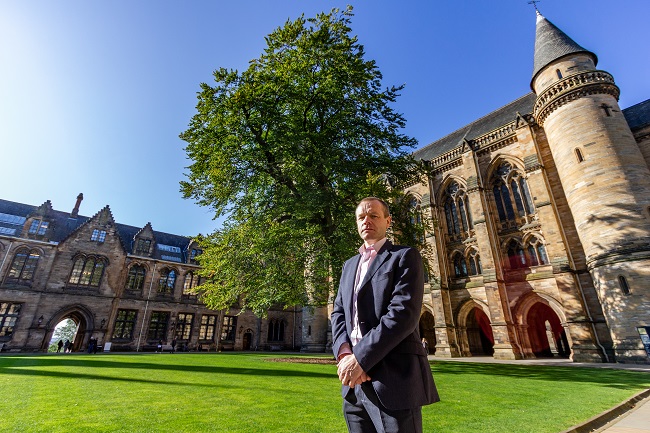
| James (0:09) | You're listening to a podcast from the Health Tech Research Centre in Brain and Spinal Injury and I'm really, really pleased to have a distinguished guest with us, Dr Willie Stewart, who is a neuropathologist from the Queen Elizabeth Hospital in Glasgow. And Willie, your area of interest really I guess is traumatic brain injury, is that right? | |
| Willie (0:29) | I guess there are not many people who have met a brain pathologist before, so I should probably start with that definition. And what I do is I take materials that come from the nervous system and try to establish a diagnosis. And so a lot of my work during the day is looking at brain tumour material, but in my research interest is trying to understand what happens to brains after brain injury and how we might be able to develop treatments and therapies to improve outcomes after brain injury. | |
| James (0:56) | Okay, so in terms of pathology, does that mean you're looking at the brains of people who are now deceased or is there stuff that you can do on people who are still kicking around? | |
| Willie (1:05) | So for most of the day-to-day work, it's on people who are still kicking around, as you put it. So they're patients who are going through surgery for brain tumours or getting a biopsy because they've got a muscle problem that's causing them difficulties. The research though, largely what we're dealing with is post-mortem material.
So we're still learning the lessons from the dead to try and inform what we do to look after people in life. So that's the research end. What we do have though is ways of kind of modelling brain injuries in materials, taking it into the laboratory and working with some fancy materials colleagues at University of Pennsylvania have where they can create brain cells in a dish, if you like, and injure them and try and figure out what's happening there. |
|
| James (1:51) | That's interesting. So you're looking at damage, not just to the whole structure of the brain, but actually really on that kind of cellular level. | |
| Willie (1:58) | Yeah. So I mean, over the last 20 years or so, my research kind of interests have grown to the point where we now talk about research from cells through to society. So at one end, we're looking at cells grown in the laboratory, which you can stretch and poke and prod and try and see what happens to them.
And at the other end, we're looking at big data, societal data, you know, what happens to the population in the world who have had brain injury and trying to understand that. And each end, you know, from looking down at a microscope at cells all the way to looking at big data in society, they kind of meet in the middle and inform what we do in the laboratory and try and understand human pathology. |
|
| James (2:39) | So can you make a direct correlation between that cellular damage and the effect it will have on an individual? | |
| Willie (2:47) | No, but what we see is we look at the cellular damage and we think, well, what would happen if that were damaging thousands of neurones in the brain or cutting off connections between sections of the brain? What kind of things would we expect to see? How might patients develop problems after that?
So then what we do is we go to the population data, we go to the clinical data and see whether we can see the same things happening there. Can we see evidence of what we see down the microscope happening in our patient populations and vice versa? You know, a lot of our work is seeing what happens in patient populations. So how do people survive and overcome brain injury and what problems do they meet? And then so we're looking if that's a problem they're meeting, can we can we recreate that or see that when we take it back into the laboratory? And if so, can we then start to unpick it down to its component parts and figure out what the real problem is? |
|
| James (3:41) | Yeah. And I guess the hope is that we understand that kind of mechanism, we might be able to develop some kind of interventions to help people make better recoveries. | |
| Willie (3:49) | Exactly. So and of course, there's stages of intervention. So one of them is in understanding what the problem might be and perhaps how people develop that problem.
Is it a way of spotting who's getting into trouble early on? So if we say 100 people survive a brain injury, but we know that, you know, a handful of them do quite badly. Is it a way of picking that handful out early on so that we can we can intervene early on? And that may be support services, it may be interventions in their life or at work. Ultimately, one day it could be developing the drugs and developing those kind of measures that can, you know, modify the course of their outcomes. So, yeah, it's taking all these lessons and blending them into, you know, outcomes, interventions in some way. And we may go on to talk about sport, how we intervene in sport to try and prevent late outcomes. There are different ways. People often think of drugs as being the big intervention, but there are other things we can do which are just as beneficial at times. |
|
| James (4:46) | Yeah. And I do want to pick up the sport thing because I'm really interested in the FIELD study that you've been leading and people may have heard your name when you got in the news a few years ago showing a link between professional sports people and sort of negative outcomes, dementia in later life, but earlier than you might normally expect that. | |
| Willie (5:05) | Yeah, that's actually quite nice. Thanks for bringing it up. So it's a FIELD, just to explain that it was a triumph of an acronym for me, because it stands for football's influence on lifelong health and dementia outcomes.
And so that acronym becomes FIELD. And of course, the last thing we did was ever go into a field to do any study on this. It was all done through electronic health records data. And the reason we did that, it's a good example, because what we were seeing when we were looking down a microscope, we were working with former footballers and families who had developed problems in life and who developed dementia and donated their brains for our examination. And we were seeing a very specific pathology in those brains, this thing called CTE or chronic traumatic encephalopathy to give it a Sunday name. So CTE for short, very specific dementia pathology. And we're seeing this repeatedly. But what we didn't know was, did this mean anything? Did this mean individuals were developing dementia or more dementia or an unusual dementia? And there's no way to answer that by peering down a microscope in a laboratory. The only way to answer that is to look at population data and ask a question. Do footballers have more dementia than you'd expect? And if so, does it look different to what you'd expect? And so this is what we did. We used what we call electronic health records. So in Scotland, everybody's got a footprint of their interactions with health service, which is stored electronically. And so we could pull that information out from Scottish health records and see do footballers age differently to a normal population? And if so, what does that look like? |
|
| James (6:46) | Yeah. And so, cut to the chase. Is sport good for you or bad for you? | |
| Willie (6:51) | Well, that's a really important question. The chase, the important underlying message is that all the data we find is that sport is good for you. So among our footballers, the headline is that we see that they were living slightly longer, that their risk of cardiovascular disease, the risk of cancer, risk of depression, risk of alcoholism, their weight was better.
So all of these things, less diabetes, all these brilliant health factors were there. And if nothing else was going on in their life, you would expect taking all those factors into account, they would have lower rates of dementia because these are all factors which would influence your risk of dementia. But the reality is that when we looked at risk of dementia among our footballers, we found it was very much higher than we'd expect. So in terms of all the dementia-like conditions, we found that there were about three to fourfold higher risk than we'd expect from general population. So sports, football, professional level football is good for your general health, but for your brain health, it just didn't seem to be such a good thing. And that's what worries us. |
|
| James (8:01) | So that's kind of an interesting result. I guess we're not surprised that people who exercise regularly tend to live longer and have better health, but this dementia risk is worrying. Is that related to something specific?
Is it to do with heading the ball or? |
|
| Willie (8:16) | Well, and this is where it comes into, you know, where I began was interest in brain injury, because the reason that people were asking us to look at brains of former footballers, former rugby players and others was because of this worry about head impacts and brain injury in sport. And could it be causing a problem? And of course, we saw this funny pathology, which is only related now to head injury and head impacts.
We don't find it anywhere else. And so when we then see that the rates of dementia are also higher in these populations, we ask the question, well, is this funny pathology related to this very much higher risk of an outcome of dementia? And of course, it's very difficult to do that because in the electronic records population, we don't, you know, the brains haven't been examined there. We just know that somebody's had a diagnosis of a dementia. And these diagnoses are often a bit inaccurate, but the best fit. And so we have to think of what else can we use as a, if you like, a surrogate, a stand in for head injury, head impact. And if you know anything about football, and I've learned a lot more about football in the last five or six years than I ever thought I would ever need to know. But footballers, of course, depending which position you're in, depends how much head impact and what your risk of head injury is. And so goalkeepers don't head the ball. They've got hands. So why would they put their head in the way? And when we look at their risk of dementia, it's about the same as individuals in the population is. So people who don't head the ball and don't have a very high risk of head injury have a dementia risk much the same as the population. Defenders though, head the ball an awful lot. And they have quite a high rate of head injuries compared to other positions. And their risk of dementia is very much higher than we'd expect, about fivefold higher. And as you move up the field towards the forwards, then the risk begins to diminish slightly again. Also, the longer that you play the game of football, the higher risk of developing dementia. So something about being exposed to football modifies your risk of dementia. So I think we can put these together and say, well, actually, it's, you know, we've got the pathology, which is unique or unusual. We've got the heading association. It seems to be those positions for head injury, head impacts important. And the longer you play and say, well, actually, our worry is this is head injuries and head impacts in the sport, which are causing this problem. |
|
| James (10:35) | Presumably it's, because of that longer term thing. It's about repeated exposure. Yeah, yeah. | |
| Willie (10:40) | So, you know, who hasn't banged the head at some point in the life and who hasn't participated perhaps in a sport where they've had a few bangs in the head? What we're seeing, though, in these professional elite footballers is something quite different, where, you know, some estimates we're working with people with families and some estimates they would say is that their husband or father may have hit the ball something like 70,000, 80,000 times over a career spanning perhaps 15, 20 years. That's an awful lot of bangs in the head.
Now, going back in those days, we weren't terribly good at recognising the sports related brain injuries, not the way we are now. But even if you take those and put them to the side, just talk about just bangs in the head, you know, just being hit in the head by a ball 70,000, 80,000 times, you know, that cumulative damage is what we're concerned about. That's what we think is the problem is those many, many tens of thousands of bangs in the head. |
|
| James (11:34) | So I guess then coming back to what you're saying earlier on about the intervention might not be a drug, it might be in this case, prevention. So just stop people doing that or reducing the number of headers at least. | |
| Willie (11:45) | Well, yeah. And I guess the other message as well is that we know from our footballers that their general health is really pretty good, you know. So what we're doing is stop people playing football.
That would be a terrible thing to do because we'd have diabetes and we'd have heart disease and we'd have cancer and we'd have all these other things. So we don't want to stop that. We want to keep that. But what we're going to deal with is this this troubling problem, which is the brain health, you know, the dementia side of it. And if and if we've got this, well, it sounds like a simple thing. Don't bang your head so many times. Maybe we can encourage people not to bang their head so many times and that will solve the problem or at least reduce the problem of dementia while keeping the fun side, the important side, which is the health benefits, and sport in the UK certainly has been pretty responsive to that. And so we're seeing, at youth levels, there's there's really no heading now until adolescence. And even then, it's very limited introduction. And even up to the seniors, adult level, amateur and through to professional level, they've done their best to cut it back as much as possible. And the way I like to think of it is if you think of that footballer with 70,000 headers, how many of them where the goal saving or the goal scoring opportunities on a Saturday afternoon, we all cheered on probably just a thousand or two thousand at most. Where did the rest of them come? The rest of them come during the week when nobody's watching other than the coach. So if we can get rid of 65, 67, 68,000 headers, but keep the ones that we all cheer on, then surely that has to be some benefit somewhere. |
|
| James (13:18) | Yeah. So does that involve just a change to kind of practise and training that sort of off the pitch stuff or is it a sort of more fundamental change of the rules? I mean, you talked about children not doing it.
And there are some guidelines now that say under 12s no heading. |
|
| Willie (13:32) | So it's a bit of both. I mean, again, I've learned a lot over the last 10, 15 years of working with with global organisations and national organisations in sport. And for all sorts of reasons, we won't go into.
They're kind of reluctant to move too much on the rules of elite sport because, you know, that's their that's a prime package. That's where the income comes. That's where everybody's paying attention to. But when you talk to them about, well, let's talk about your next generation, the youth, the adolescents, the amateurs, we can modify what was happening there and it won't influence Premier League football or international football at all. It'll just make it a safer game and a more engaging game for people. And so we've made a lot of inroads there. And some of that has been real change. So, you know, English football and Scottish football, the rules are for under 12s, there is no heading. That's a rule. That's been real change. And now if the kids do inadvertently throw their head in front of the ball, there's a free kick. So it's against the rules. As you get though into the seniors, it's less about rules and more about bringing people along and trying to modify behaviours. And so, you know, with Scottish football, for instance, colleagues of mine who work within Scottish football sat down with the coaches, managers and said, here's the problem. Here's what we'd like to do. How can we all work together on that? And so together they came up with a collaborative idea of how to cut back on heading and they're trying to stick to it. I think we're a wee bit away from saying that in the adult professional sport, we're going to change the rules and ban heading as people like to bring up. I think, again, go back to that 70,000 headers, there's 65,000 of them we could probably deal with first before we get to the last couple of thousand in match. And if we make all these changes and we find out that our science evolves, we realise that actually even one header is too many. It seems unlikely, but one is a worry. Then we may talk about, do we have to change the rules of the game? Or 20 years from now, we find out even 2,000 headers is 1,500 too many. Maybe we have to change the rules of the game. But I think we're a long way from that. We've got a lot we can deal with before we get to that point. |
|
| James (15:55) | Yeah, I guess there's this kind of resistance, you know, oh, you're going to change the game, you're going to ruin the game. But the rules have changed a number of times over the 100 years or so, haven't they? Since they were kind of established. | |
| Willie (16:05) | So that's right. So we had a fun thing. We had a meeting in Cambridge a couple of years ago last year, which was the International Neurotrauma Society's meeting in Cambridge, you know, an opportunity every couple of years for everybody within brain injury research to get together and talk science.
But we also thought, well, that's an opportunity to do something else, but a bit of fun on the side, because it turns out the rules of football originated within Cambridge on a field, you know, a common green in Cambridge, where there's a concrete plaque commemorating that event. Now, Oxford has a bit of an argument with that, and I think Sheffield too. But let's just run with this, that for the purposes of our meeting, the rules were invented in Cambridge. And so what we did was we had a fun football event where we had an international select of scientists and people attending the meeting versus the Cambridge scientists and people attending the meeting in a football match, demonstration football match, where it was a bit like American football, that we had four quarters instead of two halves. But each of these quarters in the match, we played with different sets of rules depending on the era or where we were doing. So we started with the very original football rules, which was, I think, something like 18 and 19 folk on the field, and all sorts of rules about forward passing, which was not allowed and all sorts of crazy stuff. And it was chaotic, but it was the rules of, you know, 1863. And then we played with modern rules, then we played with youth rules with no heading, and then we played a hybrid of what might the future look like. And part of that was to demonstrate that you could have a great fun and game of football, whichever rules you were playing, it was just more chaotic or less chaotic. But also that tweaking the heading rule didn't really make a big difference to how much enjoyment you got from it. So, you know, it's possible to still play that brilliant game without necessarily banging your head quite as often as we do now. |
|
| James (18:00) | So your work mostly has been about kind of football. What about other contact sports, rugby? There's obviously lots of collisions in the sport like that. | |
| Willie (18:08) | It's interesting because, you know, football captures the headlines and football, you know, attracts attention. But actually, you know, I came into this for brain injury, not necessarily football. My background is actually, you know, rugby.
So if I was going to start with a sport, I'd have started with rugby. But that's not necessarily how the history is presented to me. But what we really started in was looking at people who'd sustained a single moderate or severe brain injury. So that's people who'd crashed the car or who had a significant fall or an assault. And we were interested in how that modified the brain, you know, over the years and decades afterwards. And there's a link there with higher rates of dementia. So we were looking at that around about the same time a story started to come through in American football that perhaps there was a dementia problem with pathology there. And then I kind of had conversations about, you know, American football is like a softened version of rugby. So if there's a problem in American football, we'd expect a problem in rugby. And to be honest, you know, in rugby, you know, if we saw a problem, we're spreading our wings and thinking, well, actually, maybe it's contact sport. It's not a contact sport, but it's all contact sports where there's significant head injury, head impact. And so we have looked in rugby and we see very much similar things there that the same sort of pathology we can demonstrate in former rugby players and the risk of dementia in former rugby players is there too. It's about, it's not quite as high as threefold. It's about doubling the risk of dementia, but it's there. And of course, we can get into the amateurishness of rugby back in the day, the data we've been collected, the impacts in rugby are different and probably less frequent than in football. But we see it's a problem with contact sport where repetitive head impacts and risk of head injury is high. So American football, rugby, boxing, you know, going back in the day, football, ice hockey, it goes on. |
|
| James (20:06) | Yeah. And I guess in the States, very litigious. And they had some big changes over there because there was some big kind of landmark cases, weren't there, putting stuff forward.
Are we seeing a similar drive in the UK? We don't sue people quite as readily over here, but. |
|
| Willie (20:23) | Yeah. Although there are significant numbers of former footballers and rugby players now looking at legal action against sport and perhaps the way they've been looked after. I think, I mean, I tend to stay well away from these kind of things because I think it's really difficult.
I mean, I feel for the footballers and rugby players who may be dealing with some challenges, but I also recognise that a lot of what we've understood about this has really emerged in the last five, ten years. It's a very modern phenomenon of understanding. And so it's difficult to know. And sport is trying to do what it can. Could it do more? Probably could. But it's doing a lot, particularly in the UK and has done a lot in the last year. So I tend to keep away from it. In American football, that particular case in American football, it's slightly different in that the American football side of it had established a group to study the effects of brain injury and perhaps the long term health problems related to brain injury and had perhaps not been as forthcoming with the evidence as they might have been. And so they had a case to answer whether they had necessarily acted in the player's best interest. And I think they agreed that perhaps they hadn't. And so they settled on that basis. I think rugby, football, the sports that we know from our national sports are in a slightly different position in terms of how they might respond to that. And at the moment are doing what they can within a global sporting environment to try and adapt. |
|
| James (21:56) | Yeah. And you mentioned boxing.
And I guess we have to bring it up. It seems to me that the aim of that sport is to give your opponent a head injury. Yeah. Do we need to stop boxing? From taking part that we saw in football or is it just really dangerous? |
|
| Willie (22:13) | I mean, that's a brilliant question. I mean, the truth is, and this may surprise you, in many ways, boxing for these kind of problems has got a better understanding of it and is reacting better to and dealing with it better than other sports at the moment. So, you know, boxing realised from the 60s, 70s, that if it didn't adapt, it would literally die.
I mean, you know, the call for banning boxing, the British Medical Association, I think, still asks for a ban on boxing. And so they adapted. And so medical care was put in. If you were knocked out, you would be out for weeks or months or even longer, depending on whether it was multiple injuries over the space of a year or so. You were licenced to box. So if you didn't, you know, sign up to the appropriate health measures and health reviews, then you lose your professional licence to box. And so very strict in what they do. And they do what they can to protect players. But ultimately, as you say, the quickest way to win is to inflict a brain injury on your opponent and knock them out. And then you've won the event. Now, I've got good friends who work in boxing medicine who argue that's not the purpose of boxing. The boxing is all about, you know, the scoring, the jabs and, you know, accumulating, you know, the best sequence of boxing moves. But, OK, you can do that and hang around for 12 rounds or you can just knock the guy in the first round and go and have a cup of tea. So, you know, I think people wonder, you know, I think the reality is boxing is a quick way to win. So I think in some respects, boxing, paradoxically, I think they're looking after the athletes fairly well. And let's not forget, boxing does provide in certain communities, you know, discipline, it provides an opportunity, it provides a sport that has benefits in other ways. Oddly, for somebody who's interested in brain injury, I don't call for bans on boxing. You know, I think it's regulated. I don't know why anybody would want to do it, but I can understand why they do. And I worry if we banned boxing, you know, if we removed boxing opportunities, then the side effects of that could be even worse. Mixed martial arts is a sport which doesn't have the same regulations or restrictions. Slap fighting, there's an insane sport. You know, there are other ways that people might end up inflicting more damage on themselves or in community. And actually, you know, boxing, I think, is probably not something I worry too much about. |
|
| James (24:41) | Yeah, that's good. So we've talked about the kind of professional game. What about amateurs, the five-a-side on a Sunday morning?
Do we think that these sort of, not rule changes and such, but sort of guidelines and changes in practise, are they filtering down to that sort of amateur level of sports? |
|
| Willie (24:58) | Sport is a wonderful thing, you know, and I used to play five-a-side football until, you know, not so long ago. Long ago that I wouldn't dare threaten a five-a-side court now, but not so long ago. And it was brilliant fun.
I think they are. I mean, I think in the UK, in sport, we've spent a lot of time communicating and trying to get through to people. So talking about brain injury, how to recognise it, manage it, and then, you know, UK national guidance on brain injury, which in sport, which has come out in the last couple of years. So we're doing a lot on that. There's a lot of conversations about, you know, the risks of heading and trying to adapt and manipulate that. And I think we are in many quarters getting through to people. I think if you actually go to the farthest away grassroots pitch in the middle of a village somewhere and ask them questions, it's not necessarily getting, you know, everywhere we think it is, but I think we're doing quite a good job of it. And people are aware of some of these problems. However, we can do all we can with education and information and research. Adults are adults. And if in that far distant pitch in the village where, you know, people don't get to so often, they wish to continue to, you know, head the ball, then there's not much we can do about that. This is why we focus so much on youth level adolescence, where we do have some control, you know, we're adults making decisions for them. And so what we are seeing as the adolescents of five years ago growing into the adult players, now they're carrying the message of a brain injury forward to the teams and saying, hang on a second, why would you play on with a head injury? That's just mad. Same with heading practise. They're taking that forward and saying, you know, if it's OK with you, I'm not going to bang my head off that ball 100 times this afternoon. This doesn't seem smart to me. So it's working. We're getting there. |
|
| James (26:45) | That's good and encouraging stuff. And I guess I must keep repeating this message that we don't want people to stop doing this stuff. | |
| Willie (26:53) | Over and over and over and over again in all the data. So the reason it was football's influence on lifelong health and dementia outcomes is the health part was important. You know, we didn't want to just present the data saying footballers had a four fold higher risk of dementia, full stop, because that would stop everybody.
So that's I'm out. But what we see is that footballers have so many other health and rugby players have so many other health benefits. And if and if we could almost just encapsulate those health benefits and get rid of that brain health problem, we've got we've got a wonder drug prescribing football on the NHS, you know, go out and play football. It's wonderful for your health. |
|
| James (27:28) | Yeah. And mental health as well as physical mental socialising and being active with other people is hugely important. | |
| Willie (27:34) | I mean, we see that in the data. You know, we see that the you know, the risks of depression, anxiety, mental, addiction disorders are very much lower suicide in the data from our footballers. We didn't quite have enough numbers to say with any confidence on suicide, you know, statistics gets in the way.
But we could see that there were very much fewer suicides amongst the footballers than we might have expected. So there are all these things that tell us, you know, being a professional footballer and heading towards retirement is great for your and presumably a lot of that mental health benefits because they keep in touch with their old teams. You know, they socialise amongst the they go along as the you know, the special guests of the club and sit in the stands and watch the sport. Brilliant way of keeping yourself healthy and active. So we don't want to lose that. Can't lose that. |
|
| James (28:27) | OK, so we're just about running out of time, but we're going to push you to give us a little bit of advice. So I'm playing a football match on saturday afternoon. I get a nasty clunk on the head and I feel a bit dizzy and confused.
What should I do? |
|
| Willie (28:38) | So first thing is step out of the game. You know, if in doubt, sit them out is the message. So the first thing you do is step out of the game.
What you'd also do is let your teammates or whoever's on the pitch side know that you've had a bang on the head and that you're not feeling so great yourself. For two reasons. One is that explains why James has stepped off the park and will put somebody else in. But the second thing is they can now just keep an eye on you and make sure that you're OK and you're not developing any problems at all. If you do feel that, you know, the headaches getting worse, your neck pain or you're feeling a bit uncomfortable unwell in any other way, or they think that you're becoming a bit less James, you know, you're getting a bit drowsy and beginning to worry them, then, you know, get yourself up to casualty department and get seen. If neither of those things happen, then it's about logging into the UK concussion guidance, NHS online now has the information available and you log in there, it'll tell you all about sports concussion, what to do next. So it's about just taking it easy, taking a bit of time out of sport and gradually getting yourself back into real life. Because for many of us, real life isn't playing Saturday afternoon football. It might feel like it, it might be as important, but real life, you know, getting back to work, getting back to education and then finding a way back to your Saturday afternoon football. But that important first step is don't feel right, worried at all, get off the park. |
|
| James (30:00) | Great. Very wise words there from Dr Willie Stewart. Thanks Willie ever so much for finding the time to join us on the podcast.
If you've enjoyed this, listen to other episodes, catch up on research and innovations around brain injury. Thanks for listening. |
|
| Willie (30:15) | Thanks James. |
More like this:

Charity Podcast – Anchor point
A conversation with Alyson Norman for University of Plymouth about the need for support of families of [...]

Innovation Podcast – Fetal Monitoring
James talks to Antoniya Georgieva of Oxford University about fetal monitoring and the use of AI to [...]

Innovation Podcast – Animorph
Listen to James Piercy talk with Szczepan Orlins, Founder of Animorph Coop, a company that aims to [...]