
>
| James (0:10) | Thanks for listening to another podcast from the HealthTech Research Centre in Brain and Spinal Injury, where I've been chatting to innovators and clinicians and patients and carers and frankly anybody who will spare half an hour to have a chat with me about their interesting work. So I'm really pleased to be joined by Laura Salisbury today from Knit Regen. So Laura, that's a confusing name, is it anything to do with knitting? | |
| Laura (0:35) | No, we were initially very much in the sector of knitting because we were knitting new materials to artificially activate muscles and that name worked at the time but it doesn't anymore because we've pivoted. | |
| James (0:52) | So that sounds interesting though, I know there were a group I think based in Bristol a few years ago called Knit A Neuron and they were literally using wool to make stuff. I'm guessing that's not the kind of knitting that your previous project was about? | |
| Laura (1:05) | No, we're talking piezoelectric, triboelectric and textile actuators. | |
| James (1:14) | Yeah, cool. So let me try and get my head around this. You're trying to regenerate or reproduce the nerve tissues that send information from the brain to muscles.
Is that kind of where we're about? |
|
| Laura (1:28) | So we are re-establishing a connection from severely paralysed muscles to the brain. We're doing this via a pathway which remains intact and undamaged after stroke and brain injury. Some of those boffins out there might know this as the reticular spinal tract.
It's emerging as a huge new area of research, particularly in stroke. Historically, it was thought to really dominate control of posture, locomotion balance, you know, and actually what we found is it has a tremendous contribution towards grip strength and a little bit of finer motor control. So this really excited us and we can manipulate how we use this pathway for the greater good to help stroke survivors regain movement in their hand and fingers. |
|
| James (2:29) | Wow, that sounds fascinating. Let's just sort of take a step back. So I think people are familiar with the idea that after a stroke, people might have some kind of paralysis.
They lose muscle control, usually down one side of their body and that lack of movement isn't because their arm is broken. It's because the connection between the part of the brain that controls that movement and the arm is broken. Is that right? |
|
| Laura (2:54) | Exactly. Yes. Damage. | |
| James 2:57) | So what you're saying is that there is part of that pathway connection, actually, which in most people is still there, and you're trying to use that to re-establish the connection between the brain and the muscle. | |
| Laura (3:08) | Imagine this as you have two routes to your destination, two motorways, for example. Let's call it the M1 and the M6. The M1 is damaged as a result of stroke, but actually we still have the M6 and it might take longer to get there.
It might be a bit more of a difficult route and we might not necessarily know how to go there, but we can get there. So we're using the M6. We found out how to get there from the paralysed muscle to areas in the brain which control movement and functional recovery of movement and we're able to manipulate that. |
|
| James (3:50) | Okay. So let's stretch that analogy even further then. We're going to try and use this different roadway, but what we need to do is improve the signage and get the sat-nav working so that we know how that route goes and to make that route clearer, right?
Get some of the other traffic out of the way so we can run there hopefully at the kind of speed that the M1 would have done in the olden days. |
|
| Laura (4:12) | Oh yes, and it's got a few blockages in the way, a bit of traffic. So we see that as being the intrusion of synergies which cause muscles to be potentially overactive, quite painful, quite stiff and that can be a barrier in regaining movement as well. So often you see people with contracture, levels of spasticity, a really closed fist, quite tight closed fist and curved arm potentially depending on the level of intrusion that they have and that is one of those obstacles that, you know, traffic in the motorway that we need to get through as well and just balance out so we can keep things flowing, we can keep things moving. | |
| James (4:59) | Okay, so tell me how you're doing that then. Is there some kind of fancy piece of kit which can help strengthen those pathways? | |
| Laura (5:07) | Well, I must at this point really credit Professor Stuart Baker from Newcastle University. He is a pioneer in this field and we work directly with him. He found really interestingly that the start-up sound of a machine used in hospitals fired cells in the reticular formation, we call it reticular formation.
This was almost what we call the missing piece of the puzzle. So if you imagine with electrical stimulation, for example, if you apply that to your hand, your arm, you're sending a signal, you're sending that car on the motorway but only partway there, it only gets to your spinal cord and it doesn't really get past that point. With this sound, that sound can send the car, it can unblock that motorway and it can send the car all the way to the motor cortex, the primary motor cortex and we can send that signal up and down and have a free flow of traffic through that process. It was huge, you know, this finding was huge and what we've been able to do with Stuart is work very closely with him to develop the ability to send the signal all the way from the paralysed area of the, you know, the body and for us the hand and the fingers to the brain and back again via two very, very simple stimuli. We use a tap and we use a click sound. So the tap is almost, you know, you're being poked on the arm, I would say, you know, it's a little poke on the arm and it's very effective, very precise at activating what we call the muscle spindle afferent, so fibres in the muscle which sends that signal to the spinal cord and then we pick this up by precisely timing the click sound so that car continues on its journey up to the brain and then back down again and we do this over and over and over again and the more you do it, the more gains you see. So just like with rehabilitation, you can imagine practise and practise, keep on doing that and you actually get better and you become stronger and, you know, more functional as a result of that. |
|
| James (7:35) | And keep working at it. I'm trying to get my head around this idea that sound, something that goes in through our ears is helping the pathway of messages through the spinal cord. Do we know how that works?
Is there some sort of theory about the mechanism for that? |
|
| Laura (7:49) | So there is, but it's not fully understood. It's something that we're still looking into and Stuart is avidly exploring as a movement neuroscientist. We just don't know enough about this.
There is a theory that it's sort of really shaking the saccular and the vestibular apparatus. So really interestingly, you could have a hearing impairment and potentially this still works because it's just working on a different mechanism to be able to send that signal to the brain. So we often get that question as, you know, if I have a hearing aid, if I have a hearing impairment, would this still work? And the answer up until now is yes. |
|
| James (8:37) | I guess it's another lesson that we shouldn't think of things in silos, right? There's a whole body. It's not just an ear in one department and a leg in somewhere else.
We're one coherent being, aren't we? With intricate connections that we don't fully understand. |
|
| Laura (8:52) | Absolutely. It's fascinating that, you know, even just such simple stimuli that we take for granted on a daily basis, activate pathways in our body and we're constantly responding to stimuli all the time. And actually after stroke, that can be really quite overwhelming.
So you see a lot of people that we work with, they have a lot of overstimulation, you know, and they feel that sensory overload and they suffer from high levels of fatigue as well. So that in itself as well becomes a huge barrier to being able to participate in rehab. So we really want to try and help those people who are wanting to try their absolute best and do what they can to recover. But there's so many barriers in the way that they just can't get past that. So for us, making a simple device that's passive, that you can just wear whilst you're relaxing or whilst you're, you know, going about your everyday business, we want that to be as powerful as possible and as simple to use as possible as well. |
|
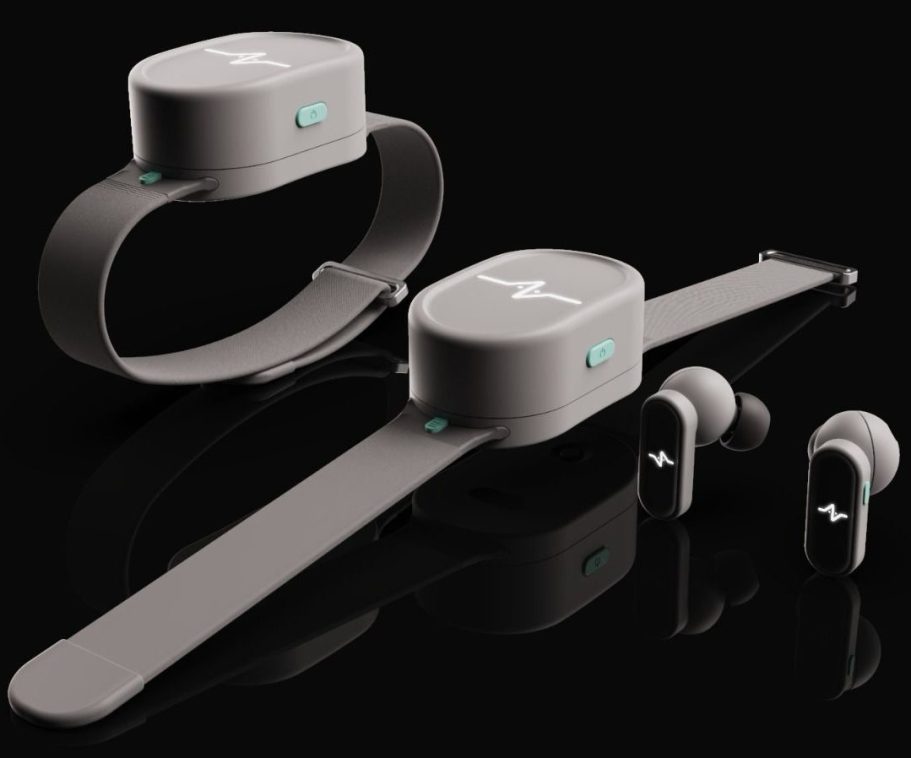
| James (9:57) | Yeah, so I'm trying to think, how does this work? So it's like a wristwatch, is it, that's tapping on your wrist and headphones for the sound? | |
| Laura (10:07) | Yeah, just a single earphone. So we only need one. So imagine a smartwatch and an earphone or your AirPod, you know, so you're just wearing those two gadgets and it's actually doing something much more substantial than your average smartwatch and earpod would do.
So yeah, we're really rethinking what everyday consumer goods can do from a medical perspective, but be something that fits into the everyday life as well of people who are using them. |
|
| James (10:42) | And how soon after stroke would somebody use this device? Is it something that is really in that kind of acute stage, in the really early stages of recovery? Or is it something that, you know, it's six months a year down the line that people start on? | |
| Laura 10:55) | So we are at the moment, we're starting to test this device more, you know, intricately with people that are six months plus post-stroke. So they're formally discharged from care in the healthcare setting, whether that be NHS or otherwise. And that's just from a safety and safeguarding precaution.
But we see huge, huge potential in placing this in the acute setting. And the earlier, not too early, but early enough, the better. But getting that into hospitals, getting that into the public sector is a huge hill to climb. And we've found that that, is that the best way to get this to people as quickly as possible, to have impact? Possibly not. So another shout out really is anybody who knows how to, you know, crack the public sector and really help move things along so that we can have huge impact for people's lives. I'd love them to reach out because we'd love to have a chat and see what we can do. |
|
| James (12:04) | Well, you heard it here, folks. Get in touch. I will add Laura's contact details and website after this podcast.
And if you're interested, do kind of make those connections. So, Laura, I'm guessing this is a medical device. It's not just a kind of support aid, is it? It's giving some sort of intervention therapy. So there's lots of sort of levels of regulation to go through. Where are you at on that kind of process? Are you classified as a medical device already or are you working towards that? |
|
| Laura (12:29) | We're working towards that. So we know we've been speaking with the MHRA. We've understood that our device is a class 2A device.
There is a software element to this and we're really careful as to how we approach this to de-risk it so we don't move into the 2B area. And we want to make this as smooth as possible to get to people. We're on our way. So our tech file is up and running. We're working on it. We've got working documents in there. And we're hoping to move through a clinical study early to mid-2026 and then gain our CE marking thereafter. So that's the aim. So 2026 is going to be a big year for us. |
|
| James (13:17) | Yeah, well, we wish you well with it. So obviously, you need to have a big kind of study to kind of really prove this. What kind of evidence have you got at the moment?
What sort of percentage of people are showing recovery of movement after using the device? |
|
| Laura (13:30) | Yeah, so it's early days. We've been compiling evidence through a step-by-step process. So we've been taking small steps to really understand what we're doing here.
The first major study that we really did was just to look at the tap itself and see how precise and how accurate we could get that, where the optimal location was on the arm and what the optimal tap profile would be. And we tested that on over 60 people. And that was last year. And we've managed to evidence that we can elicit a muscle spindle response in 95% of people that came to us. So that was really positive. And then we took all of that information into what we call our phase two, which is what we're in the middle of now. Thanks to the NIHR. So we have a pilot study running which combines the tap and the click together. We're testing that on 40 people. It's a day long. It's a very long day. So we're asking a huge amount of people coming in, nine o'clock in the morning till 5.30 at night. It's a huge ask, bearing in mind what these individuals have gone through. And we're seeing some really interesting evidence. We're halfway through this at the moment. So, you know, to make conclusive remarks would not be the right thing to do. But what I can say is that it is looking very favourable towards what we anticipated seeing in terms of cortical excitability and brainstem inhibition. We're really working towards that goal of collecting all of the data, analysing as we go, and then being able to disseminate it to the wider community. |
|
| James (15:28) | Yeah, so some promising results at the moment. If this study goes well and we get those kind of levels of kind of connection you've been talking about, how do you think the device would be used? Would it be a whole day long thing with people wear the device all of the time?
Or would it be a case of, you know, an hour a day, have a tap and a click? How do you see it sort of working in practise for people? |
|
| Laura (15:50) | Yeah, I mean, to be quite honest, the more that you do, the greater the gain. So, you know, it really depends on what people want to put into this and how long they want to use it for. We at the moment recommend in our studies a four-hour treatment cycle for using the device.
But in future, we're looking to have a larger study where we look at how many people, you know, use the device to what level and what level of compliance are we seeing and track that frequency of use. It'd be really interesting to know actually. But at the moment, we're talking about four hours a day where we're seeing significant changes in that neural pathway that we're manipulating. |
|
| James (16:35) | That's good. And does that improvement in the pathway immediately connect to improved movement and use of the hand? Or does it need to run alongside sort of more traditional rehabilitation, you know, practise actually doing practical things with the hand once you start to get this kind of movement building up? | |
| Laura (16:53) | So, we have in 15% of people who visited us so far, we've seen some really interesting immediate responses. And we don't like to say anything at the moment. We don't like to claim anything.
Of course, we can't. We haven't been through the regulation, you know, and the study hasn't concluded. But it's super interesting. We're seeing some people have, you know, flickers of movement start to return from absolutely nothing. And we're seeing some people have a more relaxed and open hand from a really tight clenched fist. So, there's promise there. But what I must say is that we anticipate that people should use this for, you know, a good couple of weeks before anything is there. And it's a case by case basis. Really depends on the level of impairment and, you know, the level of damage that's caused by the infarct post-stroke, what that looks like for them. But we do, I mean, we highly encourage, you know, activity in parallel with this. What's really important to say here is that we're working on an impairment level. So, if you imagine a video game, you're at level one and you're trying to get to level two. We're helping people to get from level one to level two. And that's just the base, the foundational level. So, you are trying to build up that strength. You're trying to build up the capacity to move the hand and the fingers. Before then you can start any sort of skill building at all. That comes a bit later down the line. So, our aim is to actually fill this gap where there's a huge amount of exclusion from other clinics and studies and, you know, physiotherapy that's run at the moment, where clinics will say, sorry, simply, you do not meet our criteria because you just don't have enough movement in your hand. And actually that's a huge barrier for many people. So, for us to build that level of movement, for us to build that level of strength back for them, that could be huge because then they can access more rehabilitation. And really that's the goal for us. We're not taking everybody through the entire pathway. We don't know if we can. We just haven't done enough work to understand the length of, you know, the gains that can be made here. But certainly in this immediate future, we're looking to try and get people up from level one to level two so they can go on to clinics such as Professor Ward's clinic at UCLH doing amazing things in Queen's Square. And, yeah, we're working closely with them. |
|
| James (19:35) | Yeah, so people can actually then sort of start to engage with those sort of physio and rehabilitation exercises, which they're excluded from because perhaps their hand is completely twisted and they can't practice picking up a cup because you can't hold a cup. Yeah, that sounds really interesting. Well, we wish you all the best with the trial as things move forwards and do stay in touch and let us know how things get on.
Is there a way that people can find out about your project? Do you have a website and stuff that people can link to and have a look at what you're doing? |
|
| Laura (20:02) | Thank you so much, James, for your kind words. We do have a website, but please bear in mind that this is a work in progress and we've been very much focused on the science here. So it's www.knitregen.com and you can reach out to me as well if you like. I'm Laura@nitregen.com. I'm always available, always happy to answer questions and answer any questions people may have in terms of point me in the right direction for this or that. If I know somebody that can help, I certainly will.
And here's to trying to help, you know, that this generation of stroke survivors really push forward and gain a new future and a new opportunity moving forward. |
|
| James (20:45) | Yeah, great to see people regaining their independence after such a catastrophic event. I will put links to the things that Laura's mentioned underneath this podcast. Do check it out and find out more about it.
Thanks so much for listening to the podcast. You know what to do. Subscribe, like, share with all your friends and relations and listen to other episodes in the series. |
More like this:
Charity Podcast – Child Brain Injury Trust
Sharon Buckland talks about the work of CBIT supporting children, young people and their families. Child Brain [...]
Charity Podcast – Headway Essex
Jennie Morrell from `Headway Essex talks about 40 years of supporting people and families living with brain [...]
Charity Podcast – UKABIF
Listen to James Piercy talk with Chloë Haywood, Executive Director of UKABIF Charity, and Jennifer Misak, Senior [...]